
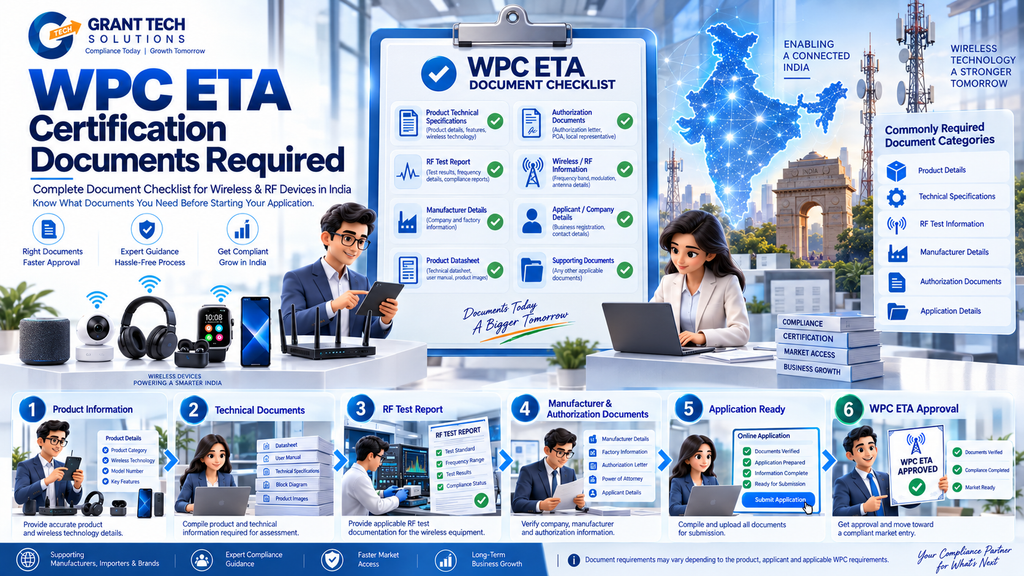
WPC ETA Certification Documents Required: Missing or incorrect documents are the #1 reason WPC ETA applications get delayed — not the certification process itself. WPC officials raise a query the moment a document is unclear, outdated, or missing a signature, and every query adds days (sometimes weeks) to your timeline. Below is the complete checklist, along with what each document is actually meant to prove, so you can prepare everything correctly before you even start the Saral Sanchar application.
Company / Applicant Documents
- Certificate of Incorporation (for companies) / proof of business registration — establishes that the applicant is a legally recognized entity in India, which WPC requires before accepting any application.
- GST registration certificate — confirms the applicant’s tax registration status and is cross-checked against the company details entered on the portal.
- PAN card of the company/applicant — used for identity verification and linked to the applicant profile on Saral Sanchar.
- Authorization letter for the signatory filing the application — proves that the person submitting the application on the portal is officially authorized to act on behalf of the company; applications filed by unauthorized signatories are a common rejection reason.
Product Documents
- RF Test Report from an accredited (ISO/IEC 17025) testing lab — the single most critical document; it’s the technical evidence that your product’s wireless emissions comply with Indian frequency and power limits.
- Product technical datasheet / specifications — gives WPC the exact operating frequency, power output, and modulation details needed to cross-verify against the test report.
- Block diagram / circuit description of the wireless module — shows how the RF component is integrated into the overall product, helping reviewers understand what exactly was tested.
- User manual (if available) — used to confirm the product’s intended use case and operating instructions match what was declared in the application.
- Photographs of the product (all sides, label visible) — visually verifies the product matches its description, including any regulatory markings already present on the label.
For Foreign Manufacturers
- Authorized Indian Representative (AIR) appointment letter — legally establishes who is responsible for filing and compliance correspondence in India on the manufacturer’s behalf (see our AIR page for details).
- FCC or EU Type Approval Certificate (as supporting reference documentation, where applicable) — not mandatory, but strengthens the application by showing the product is already compliant with an internationally recognized standard.
- Manufacturer’s declaration of conformity — a signed statement from the manufacturer confirming the product meets the technical specifications submitted.
Additional Documents (Case-by-Case)
- Import license / IEC code (for importers) — required if you’re bringing the product into India rather than manufacturing domestically.
- Previous WPC certificates for related product variants, if any — helps WPC officials quickly cross-reference if a similar product from your company has already been certified, which can sometimes speed up review.
Common Document Mistakes to Avoid
- Submitting an RF test report that doesn’t match the exact model/variant being applied for
- Uploading scanned documents that are blurry, cropped, or missing signatures/stamps
- Company name mismatches between the incorporation certificate, GST certificate, and the Saral Sanchar profile
- Forgetting to update the authorization letter when the filing signatory changes mid-process
Pro Tip
Keep RF test reports and technical specs finalized before starting the Saral Sanchar application — re-uploading documents mid-review is one of the most common causes of delay. Do one final cross-check that every document has the same company name, product model number, and applicant details before you hit submit.
FAQs
Q1. What is the most important document for WPC ETA? The RF test report from an accredited lab — the entire application hinges on this, since it’s the technical proof of compliance that every other document supports.
Q2. Do I need FCC certification to get WPC ETA in India? Not mandatory, but it’s often submitted as supporting technical documentation, especially for foreign-made products, since it can help reviewers cross-verify the product’s RF characteristics faster.
Q3. Can I submit documents in a language other than English? Documents should generally be in English or accompanied by certified translations — untranslated documents are a common reason for queries.
Q4. What if I don’t have a user manual yet? Some categories allow submission without a finalized user manual, but check current portal requirements — WPC may request it during query resolution, so it’s best to have at least a draft ready.
Q5. How long should I keep these documents after certification? It’s advisable to retain all submitted documents (test reports, technical specs, certificates) indefinitely, since WPC or customs authorities can request them for verification even after the certificate is issued.