
If you’re a foreign manufacturer wanting to sell wireless products in India, you cannot apply for WPC ETA certification directly — Indian regulations require you to appoint an Authorized Indian Representative (AIR) to file and manage the certification process on your behalf. This page explains who qualifies as an AIR, what responsibilities they carry, and how to appoint one correctly the first time.
What Is an Authorized Indian Representative (AIR)?
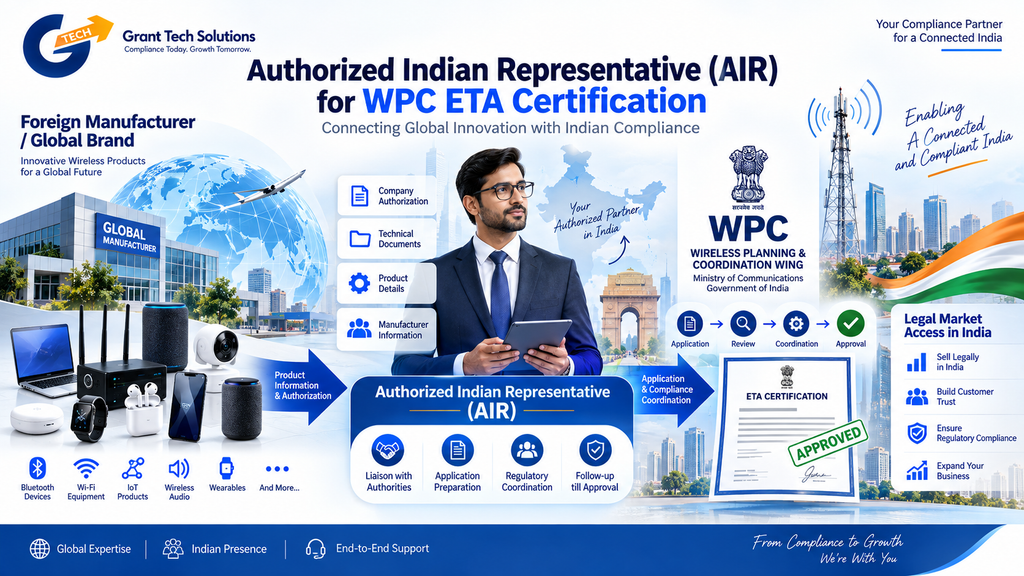
An Authorized Indian Representative for WPC ETA certification is a legally registered Indian business entity that a foreign manufacturer formally authorizes to act as its regulatory point of contact in India. Since the Department of Telecommunications (DoT) and the WPC Wing only accept applications from entities registered within India, any manufacturer without a local presence must route their WPC ETA certification application through an AIR.
Why Foreign Manufacturers Need an AIR
The Saral Sanchar portal — the single filing window for all WPC ETA certification applications — is built around Indian company credentials (GST, PAN, Companies Act registration). A foreign entity with no Indian registration simply cannot create a compliant applicant profile. The AIR bridges this gap, giving WPC a locally accountable party for correspondence, queries, and post-certification compliance.
Who Can Be an AIR?
An AIR must be a legally registered Indian entity — typically a private limited company, public limited company, or LLP with valid GST and Companies Act registration — authorized by the foreign manufacturer to act on its behalf. WPC does not certify individuals as an AIR; it must be a proper corporate entity capable of holding regulatory responsibility.
Basic eligibility checklist for an AIR:
- Valid Certificate of Incorporation under the Companies Act (or LLP registration)
- Active GST registration
- A registered office address within India
- Willingness to accept documented authorization and compliance responsibility from the foreign manufacturer
Role and Responsibilities of the AIR
Once appointed, the AIR takes on several ongoing responsibilities throughout and after the WPC ETA certification process:
- Files the WPC ETA application on behalf of the foreign manufacturer through the Saral Sanchar portal
- Acts as the official point of contact for all WPC/DoT queries, clarifications, and correspondence
- Holds responsibility for compliance and regulatory correspondence tied to the certified product
- Manages documentation, including RF test report submission, technical specification uploads, and certificate custody
- Maintains the certification record for future reference, audits, or renewal-related activity if the product design changes
Who Doesn’t Need an AIR
Entities already registered in India — Indian private/public limited companies with valid GST and incorporation certificates — can typically file directly through the Saral Sanchar portal without appointing a separate AIR. The AIR requirement specifically applies to manufacturers based outside India with no local registered entity of their own.
AIR Requirement at a Glance
| Applicant Type | AIR Required? |
|---|---|
| Indian-registered private/public limited company | No — can file directly |
| Indian LLP with valid GST | No — can file directly |
| Foreign manufacturer with no Indian entity | Yes — AIR mandatory |
| Foreign manufacturer with an Indian subsidiary | No, if the subsidiary itself is used as the applicant entity |
How to Appoint an AIR — Step by Step
- Choose a reliable Indian compliance/consulting firm or authorized entity with experience handling WPC ETA filings.
- Sign an authorization/appointment letter clearly defining scope, responsibility, and duration of the arrangement.
- Provide product technical details and RF test reports to the AIR so they can prepare a complete, accurate application.
- AIR files and manages the application through completion, including responding to any WPC queries raised during review.
Choosing the Right AIR: What to Look For
Not every Indian entity willing to act as an AIR is a good fit. Before appointing one, evaluate:
- Track record of successfully closed WPC ETA certification applications
- Familiarity with your product category (Wi-Fi, Bluetooth, IoT, drones, etc.)
- Clear, written terms on liability and compliance responsibility
- Responsiveness — since the AIR is your only line of communication with WPC during review
Risks of Skipping or Mishandling AIR Appointment
Attempting to file without a valid AIR, or appointing one without proper documentation, is a common reason foreign manufacturers face application rejection or prolonged WPC queries. An improperly authorized AIR can also create ambiguity over who holds compliance responsibility if a product is later found non-conforming — always formalize the arrangement in writing before filing begins.
FAQs
Q1. Is AIR appointment mandatory for all foreign manufacturers? Yes, foreign manufacturers without a registered Indian entity must appoint an Authorized Indian Representative before applying for WPC ETA certification.
Q2. Can my Indian distributor act as my AIR? Yes, provided they meet eligibility criteria (valid incorporation and GST registration) and formally accept the authorization responsibility in writing.
Q3. Does the AIR bear compliance liability? The AIR acts as the responsible point of contact for regulatory correspondence — liability terms should be clearly defined in your appointment agreement to avoid disputes later.
Q4. Can I change my AIR later? Yes, but it typically requires updating authorization documents and notifying WPC/DoT accordingly, along with updating the applicant profile on Saral Sanchar.
Q5. How long does it take to appoint an AIR before starting the WPC ETA application? This depends on how quickly the authorization letter and supporting documents are finalized between the manufacturer and the chosen Indian entity — typically a few days once both parties agree on terms.
Q6. Can one AIR represent multiple foreign manufacturers at the same time? Yes, an Indian entity can act as an AIR for more than one foreign manufacturer, as long as separate authorization letters and documentation are maintained for each.