
WPC ETA Certification Fees & Cost Breakdown
WPC ETA Certification Fees: The total cost of WPC ETA certification has three components — government application fee, RF testing charges and consultant/agency fees.
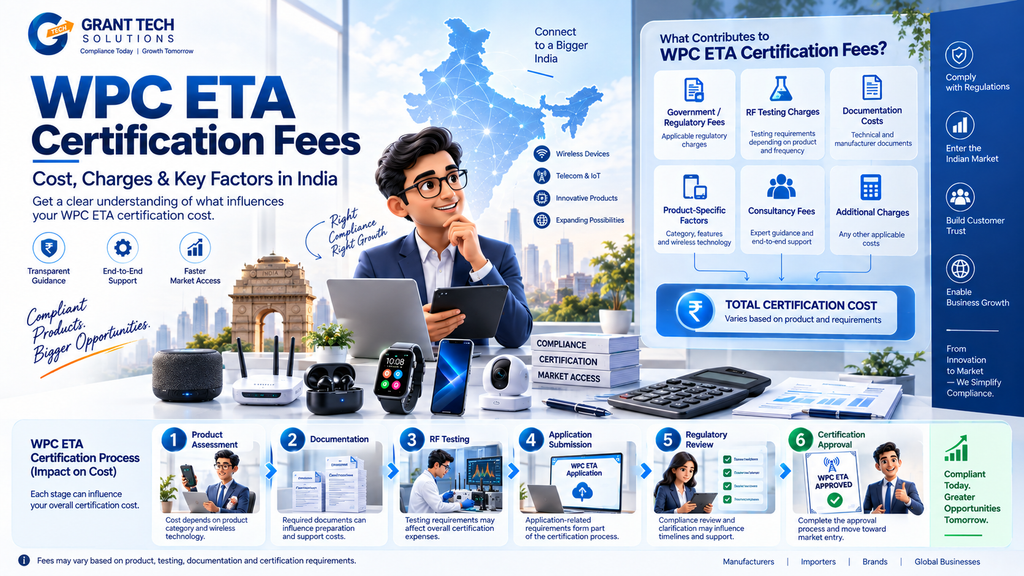
1. Government Application Fee
The Saral Sanchar portal charges a nominal statutory fee per application, which varies by product category and applicant type (individual vs company). This is fixed by DoT and doesn’t change with consultants.
2. RF Testing Cost
This is usually the largest cost component. It depends on:
- Number of wireless technologies in the product (Wi-Fi + Bluetooth)
- Testing lab chosen (accredited labs in India vs ILAC approved international)
- Product complexity
3. Consultant / Agency Fee (Optional)
If you engage a WPC consultant for documentation, liaison, and query handling, expect a professional service fee on top of government charges.
Cost-Saving Tips
- Bundle multiple SKUs with the same RF chipset in one test cycle where possible
- File via self-declaration route if your entity is eligible — it avoids re-submission delays
- Keep technical documentation ready before initiating testing to avoid re-testing costs
FAQs
Q1. Is WPC ETA certification expensive? Government fees are modest; RF testing is typically the major cost driver, varying by product type.
Q2. Does the fee vary by product category? Yes — more complex RF products (multi-band devices) usually cost more to test and certify.
Q3. Is there a renewal fee? No — WPC ETA certification has no fixed expiry, so there’s no recurring renewal fee unless the hardware changes.
Q4. Are government fees refundable if the application is rejected? Generally, statutory application fees are non-refundable regardless of outcome — always confirm current rules on the Saral Sanchar portal.