
Understanding BIS Certification Eligibility is one of the first steps a business should take before starting a BIS application. Eligibility depends on the product, applicable Indian Standard, BIS conformity assessment scheme, manufacturer location and the relevant government notification or regulatory requirement.
BIS requirements do not apply identically to every product or business. Depending on the applicable framework, Indian manufacturers, eligible foreign manufacturers and businesses involved in importing or supplying regulated products may need to meet specific BIS requirements.
Before applying, it is important to determine whether the product is covered by a BIS requirement, which scheme applies and whether the applicant is eligible to use that particular route.
This guide explains BIS Certification Eligibility in India, including who may need BIS certification, eligibility for Indian manufacturers, foreign manufacturers and importers, and how to determine whether a product is covered.
What Is BIS Certification Eligibility?
BIS Certification Eligibility refers to whether a particular product, manufacturer or applicant can obtain or use an applicable BIS certification, registration or conformity assessment route.
Eligibility is not determined only by the business type. It can depend on several factors, including:
- Product category
- Applicable Indian Standard
- BIS conformity assessment scheme
- Government notification or Quality Control Order (QCO)
- Manufacturer location
- Nature of the applicant
- Product-specific regulatory requirements
- Applicable testing and conformity requirements
Therefore, there is no single eligibility rule that applies to every BIS-related application.
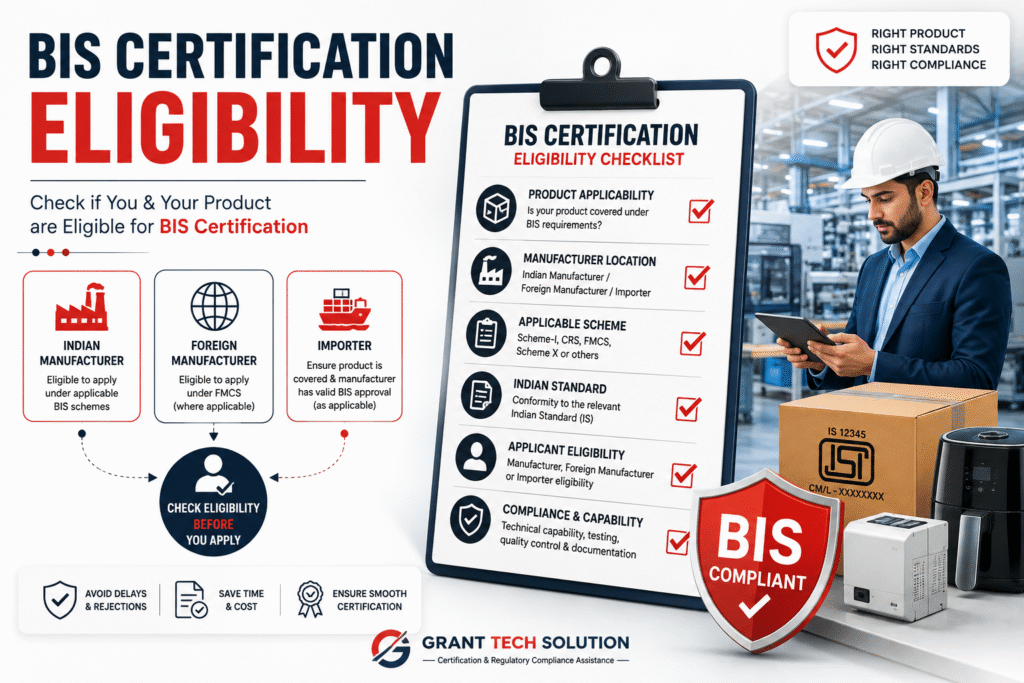
Who Needs BIS Certification in India?
BIS requirements can apply to different types of businesses depending on the product and regulatory framework.
These may include:
Indian Manufacturers
Indian manufacturers may need BIS certification or registration where their products are covered by a mandatory BIS requirement.
The manufacturer generally needs to evaluate the applicable product standard and BIS scheme before beginning the application.
Foreign Manufacturers
Eligible manufacturers located outside India may need to obtain BIS approval for applicable regulated products supplied to the Indian market.
Depending on the product and applicable framework, a foreign manufacturer may use a specific BIS route such as the Foreign Manufacturers Certification Scheme (FMCS).
Importers
Importers should check whether the products they intend to import are covered by mandatory BIS requirements.
However, importers should not assume that every imported product automatically requires the importer itself to obtain a BIS licence or registration. The applicable regulatory framework and role of the manufacturer/importer must be evaluated for the specific product.
Businesses Supplying Regulated Products
Businesses involved in manufacturing, importing or supplying products covered by mandatory requirements may need to ensure that the applicable BIS compliance conditions have been satisfied before the product is supplied in India.
Is BIS Certification Mandatory for Every Product?
No.
BIS certification is not universally mandatory for every product. BIS explains that product certification is generally voluntary, while the Central Government can make compliance compulsory for specified products through applicable regulations, notifications and Quality Control Orders.
This means eligibility and applicability must be evaluated product by product.
A business should check:
- What is the product?
- Which Indian Standard applies?
- Is the product covered by a mandatory requirement?
- Which BIS scheme applies?
- Who is the eligible applicant under that scheme?
Product-Specific BIS Eligibility
One of the most important factors in determining BIS Certification Eligibility is the product itself.
Two products manufactured by the same company may have completely different BIS requirements.
Eligibility can depend on:
- Product category
- Technical characteristics
- Applicable Indian Standard
- Product model or variant
- Government notification
- Quality Control Order
- Applicable BIS scheme
Therefore, businesses should avoid deciding eligibility solely on the basis of a product’s general category.
The specific product and current regulatory framework should be verified before applying.
Eligibility for Indian Manufacturers
Indian manufacturers may be eligible to apply for an applicable BIS certification or registration route when their product falls under the relevant BIS framework and they can satisfy the applicable conditions.
Before applying, an Indian manufacturer should generally establish:
- Identity and location of the manufacturing unit
- Product details
- Applicable Indian Standard
- Applicable BIS scheme
- Manufacturing capability
- Quality-control capability
- Required testing arrangements
- Other scheme-specific conditions
Meeting these conditions does not automatically mean that the product is eligible for every BIS scheme. The correct route must first be established.
Eligibility for Foreign Manufacturers
Foreign manufacturers can be eligible for BIS certification through applicable BIS routes when they manufacture products covered by relevant Indian Standards and regulatory requirements.
For eligible foreign manufacturers, FMCS is one important BIS framework.
BIS states that under FMCS, foreign manufacturers can apply for a BIS licence for products conforming to the relevant Indian Standards, subject to the applicable requirements.
Foreign manufacturers may need to demonstrate:
- Suitable manufacturing facilities
- Required testing arrangements
- Competent testing personnel
- Product conformity
- Applicable technical documentation
- Factory assessment readiness
- Compliance with scheme-specific requirements
An Authorized Indian Representative may also be required under the applicable FMCS framework.
Eligibility for Importers
Importers need to assess the BIS status of the products they plan to bring into India.
Before importing a product that may be regulated, the importer should determine:
- Whether the product is covered by a mandatory BIS requirement
- Which Indian Standard applies
- Which BIS scheme applies
- Whether the overseas manufacturer already holds the relevant approval
- What marking or registration conditions apply
- Whether any additional importer-related obligations apply
The importer should not assume that obtaining a generic “BIS certificate” is the correct solution for every imported product.
The applicable route should be determined from the product-specific regulatory framework.
BIS Certification Eligibility for Manufacturers vs Importers
The role of the business matters when determining eligibility.
| Applicant / Business | Typical Eligibility Question |
|---|---|
| Indian Manufacturer | Is the product covered and can the manufacturing unit meet the applicable BIS requirements? |
| Foreign Manufacturer | Is the product covered and does the manufacturer qualify under the applicable foreign-manufacturer route? |
| Importer | Is the imported product subject to mandatory BIS requirements and what compliance route applies? |
| Brand / Seller | What responsibilities apply based on the product, manufacturer and applicable regulation? |
The exact legal and certification responsibilities depend on the product and current regulatory framework.
BIS CRS Eligibility
The Compulsory Registration Scheme (CRS) is a separate BIS registration framework for notified products.
Eligibility under CRS depends on whether the product is covered by the applicable CRS requirements and Indian Standard.
For CRS-related applications, businesses may need to evaluate:
- Whether the product is notified under CRS
- Applicable Indian Standard
- Manufacturer details
- Product models
- Required testing
- Applicable registration conditions
CRS should not be treated as interchangeable with all forms of BIS product certification.
BIS Scheme-I Eligibility
BIS Scheme-I is a product certification route for applicable products.
A manufacturer seeking certification under Scheme-I must determine whether the product is covered by the relevant standard and whether the manufacturing facility and other applicable conditions can satisfy the certification requirements.
Eligibility may therefore involve both:
Product applicability
and
Applicant/manufacturing capability.
BIS Scheme X Eligibility
Scheme X is another BIS conformity assessment route applicable to specified products under the relevant regulatory framework.
The eligibility of a product or manufacturer under Scheme X depends on the applicable product, Indian Standard and regulatory requirement.
The relevant BIS documentation should be checked before deciding whether Scheme X is the correct route.
What Factors Determine BIS Certification Eligibility?
A practical BIS eligibility assessment can be broken into the following areas:
1. Product
Identify the exact product, specifications and intended use.
2. Indian Standard
Determine the Indian Standard applicable to that product.
3. Regulatory Status
Check whether the product is subject to a mandatory requirement, QCO or other applicable notification.
4. BIS Scheme
Determine whether the appropriate route is product certification, CRS, FMCS, Scheme X or another applicable framework.
5. Manufacturer Location
The manufacturer’s location can affect the applicable route, particularly for foreign manufacturers.
6. Applicant Role
Identify whether the business is the manufacturer, foreign manufacturer, importer or another relevant participant in the supply chain.
7. Technical Capability
Confirm that the manufacturer can satisfy applicable testing, manufacturing and quality-control conditions.
BIS Certification Eligibility Checklist
Before beginning an application, use this initial checklist:
| Eligibility Check | Status |
| Product identified | ☐ |
| Product specifications confirmed | ☐ |
| Applicable Indian Standard identified | ☐ |
| Mandatory BIS requirement checked | ☐ |
| Applicable QCO/notification checked | ☐ |
| Correct BIS scheme identified | ☐ |
| Manufacturer location confirmed | ☐ |
| Applicant role established | ☐ |
| Testing requirements reviewed | ☐ |
| Manufacturing capability reviewed | ☐ |
| Scheme-specific eligibility checked | ☐ |
This checklist is a starting point only. Final eligibility should be confirmed against the applicable BIS and government requirements for the specific product.
How to Check if Your Product Is Eligible for BIS Certification
To assess BIS Certification Eligibility, gather the following information first:
Product name and category
Detailed product specifications
Manufacturer location
Manufacturer type
Applicable or suspected Indian Standard
Intended Indian market/use
Existing test information
Once these details are available, the applicable BIS framework can be evaluated.
The correct approach is:
Product → Indian Standard → Regulatory Requirement → BIS Scheme → Applicant Eligibility → Applicable Requirements
This avoids starting an application under the wrong certification route.
BIS Certification Eligibility vs BIS Certification Requirements
These terms are closely related but should not be confused.
BIS Certification Eligibility
Answers:
“Am I / Is this product eligible to use this BIS route?”
BIS Certification Requirements
Answers:
“What conditions must I satisfy under this BIS route?”
For example:
Eligibility:
A foreign manufacturer may qualify for an applicable FMCS route.
Requirements:
That manufacturer may then need to meet applicable testing, manufacturing, documentation and assessment conditions.
This distinction is important when planning the certification process.
Common BIS Eligibility Mistakes
Assuming Every Product Needs BIS Certification
Not every product is automatically subject to a mandatory BIS requirement.
Choosing a Scheme Without Checking Applicability
CRS, Scheme-I, FMCS and Scheme X are not interchangeable routes.
Ignoring Product Variants
Different models, specifications or product categories may need separate evaluation.
Confusing Importing With Manufacturing
The role of the importer and the role of the manufacturer can be different under the applicable regulatory framework.
Using Outdated Regulatory Information
BIS requirements, standards, notifications and QCOs can change.
Always verify current information before making a certification decision.
When Should You Check BIS Certification Eligibility?
Businesses should ideally check eligibility before:
- Manufacturing a regulated product for the Indian market
- Importing a potentially regulated product
- Finalizing product specifications
- Starting expensive product testing
- Preparing a BIS application
- Printing regulatory markings
- Launching a product in India
Early eligibility assessment can help reduce avoidable testing, documentation and application issues.
How Grant Tech Solution Can Help With BIS Certification Eligibility
Grant Tech Solution helps businesses assess applicable certification and regulatory requirements.
Our support can include:
- Product applicability assessment
- BIS scheme identification
- Eligibility evaluation
- Documentation guidance
- Testing coordination
- Application support
- Certification-related compliance assistance
To assess the appropriate BIS route, the most useful starting information is:
Product + Manufacturer Location + Product Specifications + Intended Indian Market
Need Help Checking BIS Certification Eligibility?
Not sure whether your product requires BIS Certification or which BIS scheme applies?
Grant Tech Solution can help you evaluate the applicable BIS certification route and understand the requirements for your product.
Contact Grant Tech Solution for professional BIS certification assistance in India.