
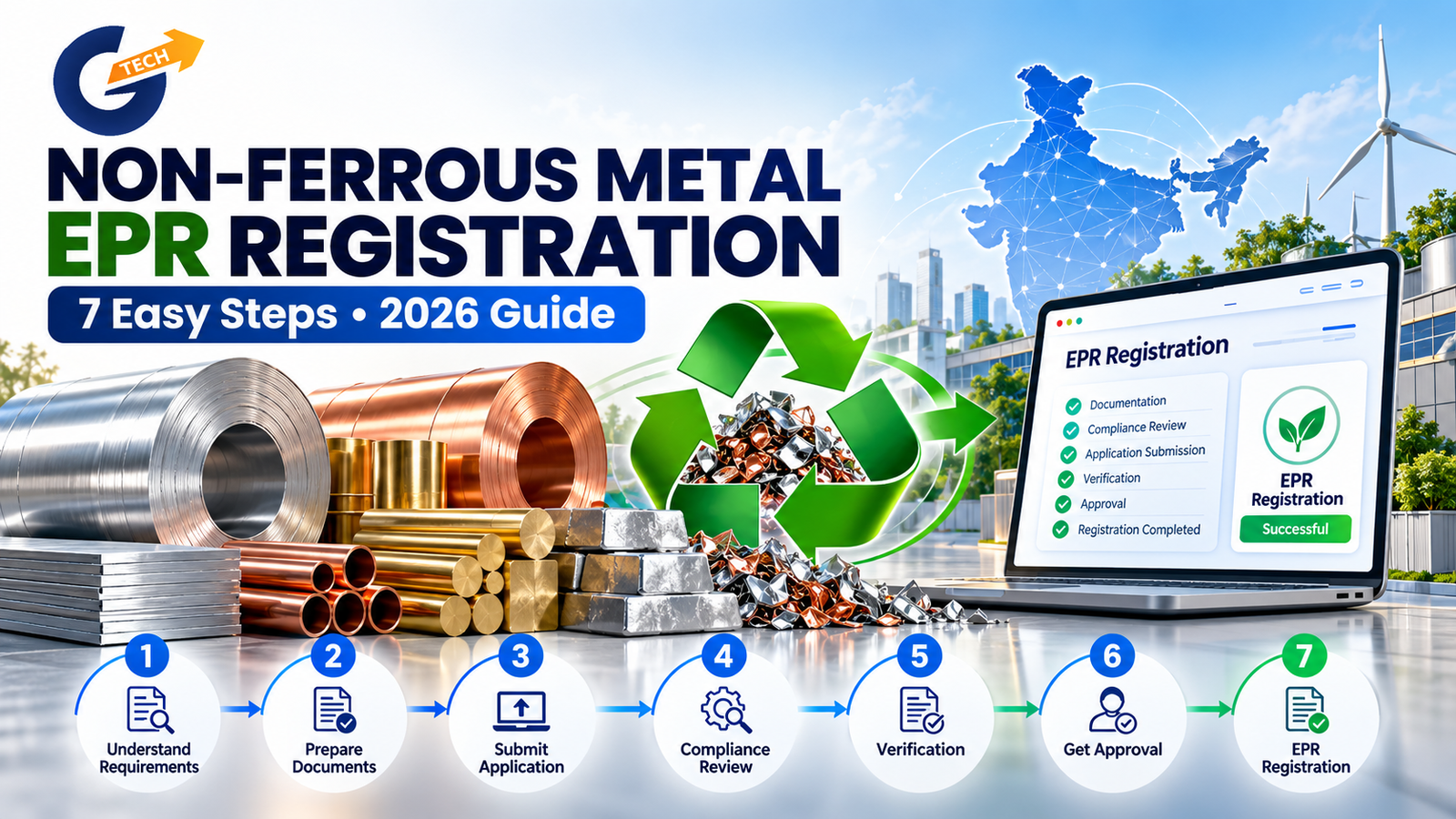
Non-ferrous metal EPR registration is now mandatory for businesses that make, sell, import or recycle aluminium, copper and zinc products in India. The rules came into force on 1 April 2026. All registration and reporting runs on the CPCB non-ferrous EPR portal.
EPR means Extended Producer Responsibility. In simple words, if you put a metal product on the market, you share the duty of recycling it at the end of its life.
This guide explains the whole process in plain language. You will learn who must register, what targets apply, which documents you need and how to stay compliant.
Image suggestion: a banner showing aluminium, copper and zinc scrap. Alt text: “non-ferrous metal EPR registration on CPCB portal”.
Why Non-Ferrous Metal EPR Matters
India uses huge volumes of aluminium, copper and zinc every year. Much of this metal ends up as scrap. A large share of that scrap is handled by small, informal units without proper pollution control.
The new EPR framework aims to fix this. It makes the value chain traceable, pushes scrap to registered recyclers and builds demand for recycled metal. As a result, businesses that act early avoid penalties and gain access to a cleaner supply chain.
The Legal Basis for EPR for Non-Ferrous Metals
The Ministry of Environment, Forest and Climate Change (MoEFCC) notified the Hazardous and Other Wastes (Management and Transboundary Movement) Amendment Rules, 2025 in July 2025. These rules added a new Chapter VIII to the 2016 Hazardous Waste Rules. You can read the official notification in the Gazette of India.
The draft first came out in August 2024. The final rules exempted some automobile-grade products and moved the start date to 1 April 2026.
Which Metals Are Covered?
The rules define non-ferrous metals as:
- Aluminium and its alloys
- Copper and its alloys
- Zinc and its alloys
Which Products Are Covered?
Schedule X of the rules lists the specified products. If your product falls in this list and contains aluminium, copper or zinc, EPR applies to you:
- Cans for beverages, aerosols and similar products
- Packaging foils for food, pharma and similar products
- Doors, windows and shutters
- Aluminium composite panels
- Aluminium partitioning, grills and similar products
- Utensils such as cookware, canisters and storage items
- Furniture such as tables, chairs, benches and ladders, including doorknobs, handles and hardware
- Roofing and ceiling sheets
- Motors, pumps and alternators (other than automobile grade)
- Conductor cables, wires and strips (other than automobile grade)
- Sanitary ware and fittings
- Electrical fittings (other than automobile grade)
- Aluminium alloy bicycles
- Transformers (other than automobile grade)
- Electric generator sets
- Centralised air conditioning plants
- Apparel products such as belt buckles, zips and shoes
- Toys
CPCB is expected to clarify the exact scope of each product. Until then, it is safer to treat borderline products as covered.
Who Needs Non-Ferrous Metal EPR Registration?
Every entity in the value chain must register on the CPCB portal. Without registration, you cannot legally operate in this space. Here is a quick look at each role.
| Entity | Who it covers | Main duty |
|---|---|---|
| Producer | Brand owners, sellers of own-brand or imported products (including dealers, retailers and e-retailers), and importers of used products or scrap | Meet yearly recycling targets through EPR certificates |
| Manufacturer | Units that make any specified product, component or spare part | Use a minimum share of domestically recycled metal |
| Recycler | Units that process scrap into recycled metal | Generate and sell EPR certificates |
| Refurbisher | Units that repair and extend the life of specified products | Generate refurbishing certificates |
| Collection agent | Aggregators of end-of-life scrap | Collect scrap and supply it only to registered recyclers |
| Bulk consumer | Entities using 1,000 tonnes or more of specified products in a year, including e-retailers | Set up collection points and hand scrap only to registered entities |
Producer vs Manufacturer: A Common Confusion
Many companies are both a producer and a manufacturer. For example, a firm that makes and sells copper wires under its own brand plays both roles. In that case, it must register in both categories.
Similarly, an importer of aluminium cookware counts as a producer. It carries the recycling target even though it does not make the product in India.
EPR Targets for Non-Ferrous Metals
After non-ferrous metal EPR registration, producers must meet a recycling target every financial year. The target is a share of the products they placed on the market several years earlier.
Recycling Targets for Producers
The rules use a simple formula. Y is the current financial year and X is the average life of the product, which CPCB will fix.
| Financial year (Y) | Recycling target |
|---|---|
| 2026-27 and 2027-28 | 10% of products placed in year Y-X |
| 2028-29 and 2029-30 | 30% of products placed in year Y-X |
| 2030-31 and 2031-32 | 50% of products placed in year Y-X |
| 2032-33 onwards | 75% of products placed in year Y-X |
Example: Say a motor has an average life of 10 years. For FY 2026-27, the producer looks back to FY 2016-17. If it sold 800 tonnes of motors that year, the target is 10%, or 80 tonnes.
The producer does not have to recycle the metal itself. Instead, it can buy EPR certificates for 80 tonnes from registered recyclers on the portal.
Recycled Content Targets for Manufacturers
From FY 2028-29, manufacturers must use a minimum share of recycled metal in new products. This recycled metal must come from recycling done in India.
| Metal | 2028-29 | 2029-30 | 2030-31 | 2031-32 |
|---|---|---|---|---|
| Aluminium | 5% | 10% | 10% | 10% |
| Copper | 5% | 10% | 15% | 20% |
| Zinc | 5% | 10% | 15% | 25% |
CPCB can grant an exemption where there is a statutory or technical limit. For example, some high-purity applications may not allow recycled input.
Return Filing Deadlines
Producers and manufacturers must file two returns on the portal each year:
- Half-yearly return: by 31 October, covering April to September of the current year.
- Annual return: by 30 June, covering the previous financial year (April to March).
Non-Ferrous Metal EPR Registration Process: 7 Easy Steps
The non-ferrous metal EPR registration process is fully online. It follows the same pattern as other CPCB EPR portals for plastic, e-waste and batteries. Here are the steps.
- Check your category. Decide whether you are a producer, manufacturer, recycler, refurbisher or collection agent. Some businesses need more than one registration.
- Create an account. Visit the CPCB non-ferrous management portal and sign up with a valid email ID and mobile number. Verify both through OTP.
- Fill in company details. Enter your legal name, address, PAN, GST, CIN and authorised person details.
- Add product and metal data. List your Schedule X products, the metal in each (aluminium, copper or zinc) and the quantities placed on the market in past years.
- Upload documents. Attach the documents listed below as clear PDF files.
- Pay the fee. CPCB charges an annual fee based on the quantity of scrap you generate, recycle, refurbish or handle.
- Track approval. CPCB reviews the application and may raise queries. Reply on time, and download your registration certificate once approved.
Note: CPCB may update portal fields over time. Always check the latest instructions on the portal before you apply.
Documents Required for Non-Ferrous Metal EPR Registration
Keep these documents ready before you start. This saves time and avoids queries from CPCB.
- PAN card of the company
- GST registration certificate
- Certificate of Incorporation (CIN), if applicable
- Aadhaar and PAN of the authorised person
- Authorisation letter or board resolution
- IEC (Importer Exporter Code) for importers
- Consent to Establish (CTE) and Consent to Operate (CTO) from the State Pollution Control Board, for manufacturers and recyclers
- Hazardous waste authorisation, for recyclers
- Product list with metal-wise quantities sold in past years
- Installed capacity and process details, for recyclers and refurbishers
How EPR Certificates Work
EPR certificates are the backbone of this system. CPCB issues them to registered recyclers based on the metal they actually recycle. Producers then buy these certificates on the portal to meet their targets.
Here are the key points to know:
- Certificates are traded only on the CPCB portal.
- Each certificate comes in a denomination between 100 kg and 10,000 kg.
- CPCB uses conversion factors to link recycler output to certificate quantity.
- A gap of more than 5% between certificates and actual recycling is treated as fraud.
Refurbishing Certificates
Refurbishers can also generate certificates when they extend the life of a product. A producer can use these to defer part of its target for the current year.
However, the obligation does not disappear. Once the extended life ends, 75% of the deferred quantity is added back to the producer’s target.
Penalties for Non-Compliance
Skipping non-ferrous metal EPR registration or missing targets can be costly. Under Rule 60, CPCB can impose Environmental Compensation (EC) on any entity that fails its EPR duties or gives false information.
Other possible actions include:
- Suspension or cancellation of registration
- Non-refundable EC for fake or inflated certificates
- Action by the State Pollution Control Board, including closure directions
In short, compliance costs far less than penalties. It also protects your brand with large buyers who now check supplier EPR status.
Common Mistakes to Avoid
Many businesses make the same errors with new EPR rules. Avoid these to save time and money:
- Registering in only one category when you play two roles
- Using wrong product weights or metal content in the application
- Missing the 31 October or 30 June return deadlines
- Buying certificates from unregistered or unverified sources
- Waiting until the year-end to plan your target
We covered similar errors for e-waste in our post on EPR e-waste certification mistakes. Most of the lessons apply here too.
How Grant Tech Solutions Helps With Non-Ferrous Metal EPR Registration
Grant Tech Solutions is a compliance consultancy with 7+ years of experience and 2,500+ completed projects. We handle EPR, BIS and other approvals for brands across India and abroad.
For non-ferrous metal EPR registration, our team takes care of:
- Checking your category and product scope under Schedule X
- Preparing and filing the application on the CPCB portal
- Calculating your yearly recycling target
- Sourcing genuine EPR certificates from registered recyclers
- Filing half-yearly and annual returns on time
- Handling CPCB queries and audits
Ready to get started? Book a free consultation with our EPR experts today.
Frequently Asked Questions
Add these with the Rank Math FAQ block so Google can read the FAQ schema.
Is non-ferrous metal EPR registration mandatory?
Yes. From 1 April 2026, every producer, manufacturer, recycler, refurbisher and collection agent of specified non-ferrous metal products must register on the CPCB portal.
Which metals come under EPR for non-ferrous metals?
Aluminium, copper, zinc and their alloys. The rules cover 18 product groups listed in Schedule X.
Do importers need to register?
Yes. Importers of products made of non-ferrous metals, and importers of used products or scrap, count as producers under the rules.
What is the EPR target for FY 2026-27?
Producers must meet 10% of the quantity of products they placed on the market in year Y-X. Here, X is the average product life set by CPCB.
Can a producer buy EPR certificates instead of recycling?
Yes. Producers can buy EPR certificates from registered recyclers on the CPCB portal to meet their targets.
What are the return filing dates?
The half-yearly return is due by 31 October. The annual return for the previous financial year is due by 30 June.
What happens if I do not register?
CPCB can impose Environmental Compensation and suspend or cancel registrations. State boards can also take action against your unit.
Conclusion
Non-ferrous metal EPR registration is no longer optional. Targets start at 10% in FY 2026-27 and rise to 75% by FY 2032-33, so early planning pays off. Register on the CPCB portal, track your product data and build a reliable certificate supply now.
Need help? Talk to the Grant Tech Solutions EPR team for a quick, hassle-free registration.