
The BIS Certification Requirements depend on the product, applicable Indian Standard, BIS conformity assessment scheme and the relevant government notification or regulatory requirement.
Businesses should not assume that every product follows the same BIS requirements. The applicable requirements can differ based on the product category, manufacturing location, testing arrangements and certification or registration scheme.
For manufacturers, importers and eligible foreign manufacturers, the first step is to determine whether the product is covered by a mandatory BIS requirement and then identify the applicable Indian Standard and BIS scheme.
This guide explains the key BIS Certification Requirements in India, including product requirements, testing, documentation, manufacturing infrastructure, quality control, labelling and scheme-specific compliance.
What Are BIS Certification Requirements?
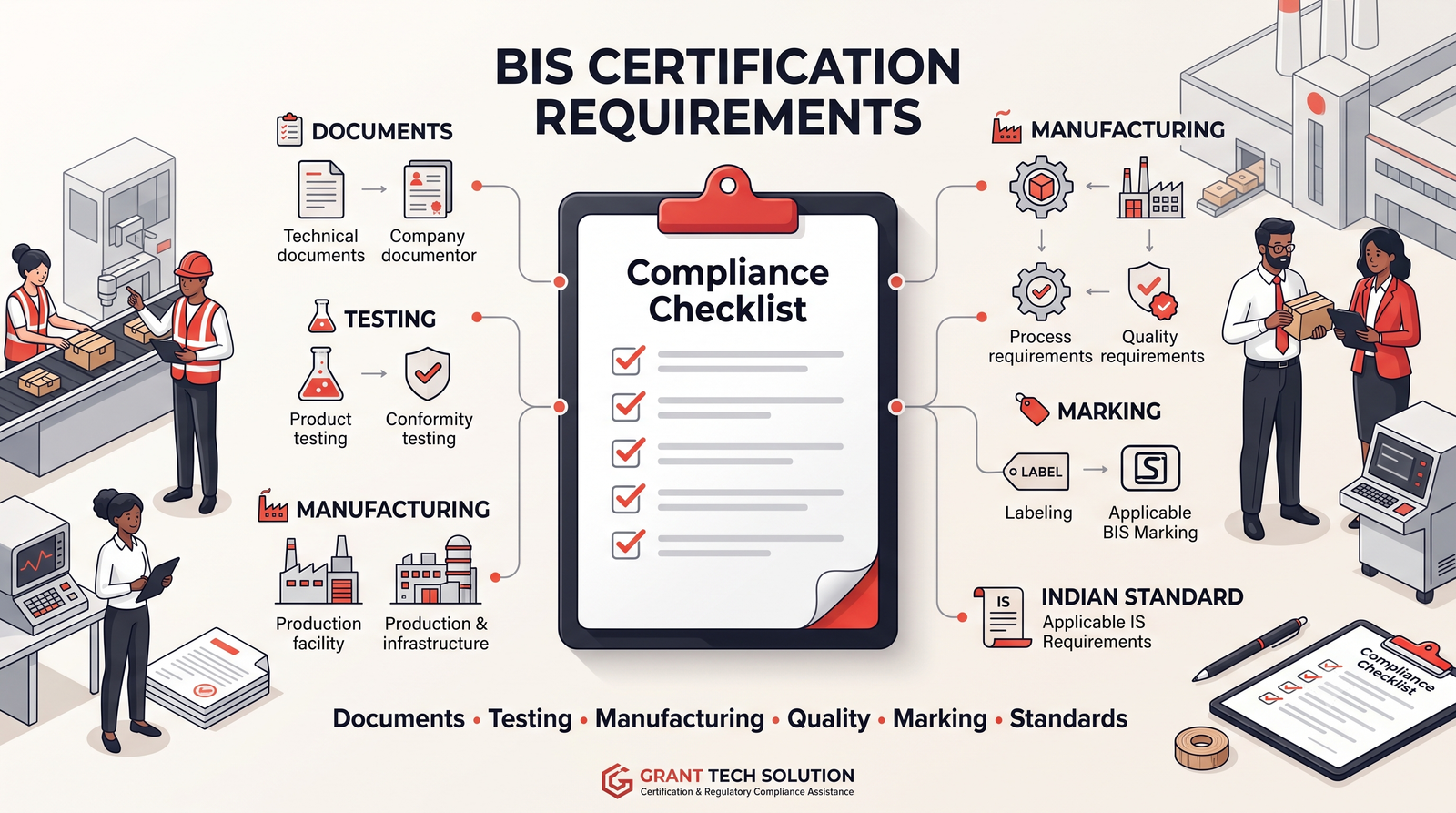
BIS Certification Requirements are the technical, manufacturing, testing, documentation and compliance conditions that a manufacturer or applicant must satisfy under the applicable BIS certification or registration framework.
These requirements can include:
- Applicable Indian Standard
- Product specifications
- Manufacturing infrastructure
- Production process controls
- Quality-control arrangements
- Testing facilities or testing arrangements
- Product testing
- Technical documentation
- Labelling and marking requirements
- Scheme-specific documents
- Applicable declarations and undertakings
- Ongoing compliance requirements
The exact requirements must be determined according to the specific product and applicable BIS scheme.
Who Needs to Meet BIS Certification Requirements?
BIS requirements can apply to different businesses depending on the product and applicable regulatory framework.
These may include:
Indian Manufacturers
Manufacturers in India may need to comply with BIS requirements when their products are covered under applicable mandatory certification or registration requirements.
Foreign Manufacturers
Eligible foreign manufacturers may need to obtain BIS certification through the applicable route when supplying regulated products in India.
Certain foreign manufacturers may fall under the Foreign Manufacturers Certification Scheme (FMCS), depending on the product and applicable requirements.
Importers
Importers should determine whether the products they intend to bring into India are subject to mandatory BIS requirements.
However, an importer should not assume that every imported product automatically requires BIS Certification.
The applicable product, manufacturer, Indian Standard, scheme and current regulatory notification should be checked first.
Key BIS Certification Requirements
Although requirements vary by product and scheme, the major areas businesses should evaluate include:
- Applicable Indian Standard
- Product conformity
- Manufacturing infrastructure
- Production process controls
- Quality-control system
- Testing facilities and arrangements
- Product testing
- Technical documentation
- Labelling and marking
- Scheme-specific compliance
- Application-related requirements
- Ongoing compliance
Let’s look at each of these in detail.
1. Applicable Indian Standard Requirement
One of the most important BIS Certification Requirements is identifying the correct Indian Standard applicable to the product.
The Indian Standard establishes the technical requirements against which the product may be assessed.
Before applying, the manufacturer should determine:
- Product category
- Product specifications
- Applicable Indian Standard
- Relevant product standard requirements
- Applicable BIS conformity assessment scheme
- Testing requirements
- Applicable regulatory notification or QCO
Selecting the correct standard is critical because the testing, documentation, manufacturing and quality-control requirements can depend on it.
2. Product Conformity Requirement
The product must conform to the applicable requirements of the relevant Indian Standard and BIS scheme.
Depending on the product, conformity may relate to:
- Product specifications
- Dimensions
- Materials
- Performance characteristics
- Safety parameters
- Construction
- Electrical or mechanical characteristics
- Marking
- Testing criteria
The exact conformity criteria are product-specific.
A manufacturer should therefore review the relevant Indian Standard and applicable product-specific BIS documentation before beginning the certification process.
3. Manufacturing Infrastructure Requirements
For applicable BIS product certification routes, the manufacturing facility may need to have suitable infrastructure to consistently produce conforming products.
Depending on the product, this may include:
- Appropriate production machinery
- Manufacturing equipment
- Production facilities
- Storage arrangements
- Quality-control facilities
- Testing equipment
- Supporting infrastructure
The required infrastructure depends on the relevant product standard and applicable BIS scheme.
The goal is not simply to produce one compliant sample but to demonstrate the ability to consistently manufacture products that meet the applicable requirements.
4. Manufacturing Process Requirements
The manufacturer may also need appropriate process controls to ensure consistent product quality.
Relevant controls can include:
- Raw-material controls
- Production-stage checks
- Process parameters
- In-process inspections
- Final product inspection
- Testing procedures
- Handling and storage controls
- Records of quality checks
The exact controls depend on the product and applicable requirements.
Manufacturers should document their relevant production and quality-control processes before assessment where such documentation is required.
5. Quality Control Requirements
Quality control is an important part of applicable BIS certification frameworks.
A manufacturer may need suitable arrangements for:
- Incoming material inspection
- In-process quality checks
- Finished-product inspection
- Sampling
- Testing
- Maintaining test records
- Handling non-conforming products
- Corrective actions
- Maintaining relevant quality records
For applicable product certification schemes, the Scheme of Inspection and Testing (SIT) can define requirements relating to production controls, sampling, testing, acceptance criteria and other applicable controls.
Therefore, manufacturers should review the product-specific requirements rather than using a generic quality-control checklist.
6. Testing Requirements for BIS Certification
Product testing is another important component of BIS compliance where testing is required under the applicable scheme.
Testing helps establish whether the product meets the technical requirements of the relevant Indian Standard.
Depending on the applicable scheme and product, testing arrangements may involve:
- Testing at an appropriate laboratory
- Testing at the manufacturing premises where permitted
- Testing through prescribed laboratory arrangements
- Routine testing
- Periodic testing
- Sample-based testing
The applicable product standard and BIS documentation should be checked to determine:
- What needs to be tested
- Which parameters need to be tested
- Testing frequency
- Applicable test methods
- Sampling requirements
- Acceptance criteria
7. Testing Equipment Requirements
For applicable certification routes, manufacturers may need suitable testing facilities or equipment at the manufacturing premises.
The required equipment depends on the applicable Indian Standard and product.
Manufacturers should evaluate:
- Required testing equipment
- Equipment specifications
- Testing capability
- Calibration requirements, where applicable
- Qualified personnel
- Testing records
- Maintenance arrangements
Not every product requires the same testing infrastructure, so the relevant product-specific requirements should always be checked.
8. BIS Certification Documentation Requirements
Documentation is an important part of the certification process.
Depending on the product and scheme, the applicant may need to provide information relating to:
- Manufacturer details
- Factory information
- Product specifications
- Technical documents
- Product drawings
- Manufacturing process
- Quality-control arrangements
- Testing facilities
- Test reports
- Labelling and marking
- Declarations
- Undertakings
- Scheme-specific documents
The exact checklist should be confirmed according to the applicable Indian Standard and BIS scheme.
9. Product Specification Requirements
The product submitted for certification must correspond to the applicable requirements.
Manufacturers should maintain accurate information about:
- Product name
- Model or type
- Technical specifications
- Materials
- Dimensions
- Ratings
- Components
- Product variants
- Manufacturing location
Where multiple models or variants are involved, the applicable BIS requirements should be evaluated carefully rather than assuming that one certification automatically covers every product.
10. Labelling and Marking Requirements
Products covered by applicable BIS certification or registration requirements may need to comply with specific labelling and marking conditions.
Depending on the scheme, requirements may relate to:
- BIS Standard Mark
- Licence or registration details
- Product identification
- Manufacturer information
- Applicable marking information
- Packaging information
- Other scheme-specific details
The exact marking requirements depend on the relevant BIS scheme and product.
Manufacturers should not use the BIS Standard Mark or other BIS-related markings unless they are permitted under the applicable licence, registration or regulatory framework.
11. BIS Scheme-Specific Requirements
Not every BIS application follows the same requirements.
The applicable requirements depend significantly on the scheme.
BIS Scheme-I
BIS Scheme-I is associated with product certification for applicable products.
Depending on the product, requirements can include:
- Applicable Indian Standard
- Manufacturing infrastructure
- Process controls
- Quality-control arrangements
- Testing facilities
- Product testing
- Documentation
- Factory assessment
- Applicable marking requirements
BIS CRS Requirements
The Compulsory Registration Scheme (CRS) is a separate registration framework for notified products.
For products covered under CRS, applicants need to meet the applicable requirements relating to:
- Relevant Indian Standard
- Product testing
- Test reports
- Manufacturer information
- Product details
- Application documentation
- Registration requirements
- Applicable marking
CRS requirements are product-specific and should be verified against the applicable notification and BIS requirements.
BIS FMCS Requirements
The Foreign Manufacturers Certification Scheme (FMCS) applies to eligible foreign manufacturers seeking BIS certification for applicable products.
Foreign manufacturers may need to demonstrate:
- Appropriate manufacturing facilities
- Required testing arrangements
- Competent testing personnel
- Product conformity
- Required documentation
- Factory assessment readiness
- Compliance with applicable Indian Standard requirements
FMCS also involves requirements relating to the manufacturer’s authorized Indian representative where applicable.
BIS Scheme X Requirements
Scheme X is another conformity assessment route applicable to specified products under the relevant regulatory framework.
The requirements can vary according to the product and applicable Indian Standard.
Manufacturers should verify the applicable Scheme X requirements before preparing an application.
BIS Certification Requirements for Indian Manufacturers
Indian manufacturers should generally evaluate the following areas before applying:
Product
- Identify the applicable product standard
- Confirm product specifications
- Identify applicable models or variants
Factory
- Manufacturing infrastructure
- Production equipment
- Process controls
- Quality-control arrangements
Testing
- Required testing equipment
- Testing capability
- Qualified personnel
- Test records
- Applicable calibration arrangements
Documentation
- Technical information
- Factory details
- Product details
- Quality-control documentation
- Applicable test reports
Compliance
- Applicable BIS scheme
- Marking requirements
- Inspection requirements
- Ongoing compliance obligations
BIS Certification Requirements for Foreign Manufacturers
Foreign manufacturers should evaluate additional requirements applicable to their manufacturing location and certification route.
Depending on the product and scheme, this may involve:
- Applicable Indian Standard
- Manufacturing facility
- Testing facilities
- Product testing
- Technical documentation
- Factory assessment
- Authorized Indian Representative requirements
- Applicable BIS application process
- Marking and compliance requirements
For eligible foreign manufacturers, FMCS may be the applicable BIS certification route.
BIS Requirements for Importers
Importers should determine whether the product being imported is subject to a mandatory BIS requirement.
Before importing a regulated product, businesses should verify:
- Product category
- Applicable Indian Standard
- Applicable BIS scheme
- Manufacturer’s compliance
- Applicable QCO or notification
- Product marking requirements
- Documentation
Importers should avoid relying solely on the assumption that a product is either “BIS certified” or “not BIS certified.” Applicability should be evaluated based on the specific product and current regulatory requirements.
BIS Certification Eligibility vs BIS Certification Requirements
These two concepts are related but not identical.
BIS Certification Eligibility
Eligibility focuses on whether an applicant/product can use a particular BIS certification or registration route.
BIS Certification Requirements
Requirements focus on what the applicant must satisfy or provide to obtain and maintain the applicable approval.
For example:
Eligibility → Can this product/manufacturer apply under the relevant scheme?
Requirements → What standards, testing, documentation, infrastructure and compliance conditions must be met?
This distinction is useful when planning the BIS certification process.
Common Mistakes in Meeting BIS Certification Requirements
Businesses can face problems when they:
Choose the Wrong Indian Standard
The applicable standard should be confirmed before testing or application.
Use an Incorrect Testing Route
Testing requirements should be determined according to the applicable BIS scheme and product.
Prepare Incomplete Documentation
Missing or inconsistent information can result in queries and delays.
Ignore Manufacturing Requirements
Certification is not only about submitting documents. Applicable manufacturing and quality-control requirements may also need to be demonstrated.
Assume One Requirement Applies to Every Product
BIS requirements are product- and scheme-specific.
Ignore Regulatory Updates
Indian Standards, QCOs, notifications and BIS requirements can change. Businesses should verify the current requirements before applying.
BIS Certification Requirements Checklist
Use this checklist as a starting point:
| Requirement | Check |
|---|---|
| Applicable Indian Standard identified | ☐ |
| BIS scheme identified | ☐ |
| Mandatory requirement verified | ☐ |
| Product specifications reviewed | ☐ |
| Manufacturing facility evaluated | ☐ |
| Production process reviewed | ☐ |
| Quality-control system prepared | ☐ |
| Testing requirements identified | ☐ |
| Testing equipment/facilities checked | ☐ |
| Technical documents prepared | ☐ |
| Test reports arranged where applicable | ☐ |
| Labelling/marking requirements reviewed | ☐ |
| Scheme-specific documents prepared | ☐ |
| Factory assessment readiness checked | ☐ |
| Ongoing compliance requirements understood | ☐ |
How to Check BIS Certification Requirements for Your Product
Because BIS requirements are product-specific, the best starting point is to identify:
1. Product name and category
2. Manufacturer location
3. Product specifications/model
4. Applicable Indian Standard
5. Relevant BIS scheme
6. Whether a QCO or mandatory notification applies
Once these details are established, the applicable testing, documentation, manufacturing and compliance requirements can be evaluated.
BIS Certification Requirements: Quick Summary
The key requirements can be summarized as:
Product
↓
Indian Standard
↓
Applicable BIS Scheme
↓
Manufacturing Infrastructure
↓
Quality Control
↓
Testing
↓
Documentation
↓
Application & Assessment
↓
Certification / Registration
↓
Ongoing Compliance
How Grant Tech Solution Can Help
Understanding the correct BIS Certification Requirements can be difficult because the requirements vary by product and scheme.
Grant Tech Solution can assist businesses with:
- Product applicability assessment
- Identification of applicable BIS requirements
- Scheme identification
- Documentation assistance
- Testing coordination
- Application support
- Certification-related compliance assistance
Before beginning the process, we recommend identifying your product category, manufacturer location and applicable Indian Standard.
Need Help Understanding BIS Certification Requirements?
Grant Tech Solution can help you understand the applicable BIS requirements and determine the appropriate certification or registration route for your product.
Contact Grant Tech Solution for professional BIS certification assistance.